
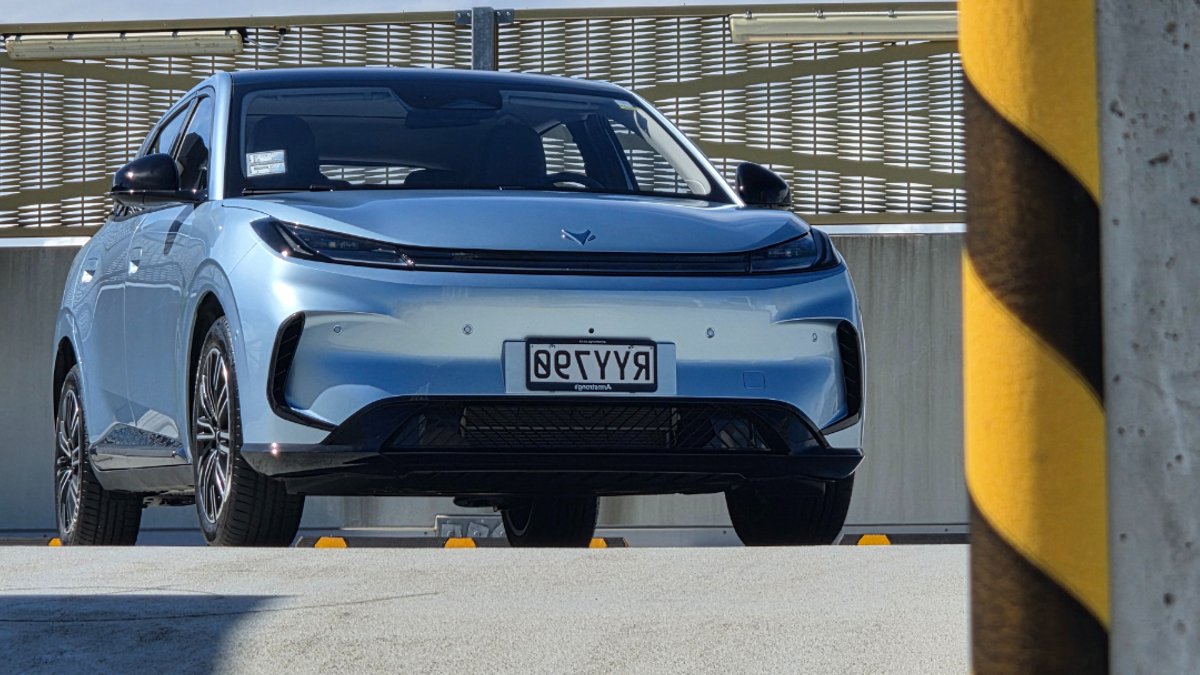
The Arcfox T1 Premium arrives in New Zealand as a city-focused electric hatch priced at $34,990 for a limited launch period, rising to $36,990 after October 30. The model follows BAIC’s 2017-born Arcfox brand, which began with the compact, rear-motor Lite and has since expanded into larger crossovers.
Design cues and cabin appointments
Outside, the T1 keeps a conventional hatch silhouette but adds distinctive touches, such as a stylised fox badge on the bonnet and a two-tone “Vana Blue” paint option that costs an extra $750. Standard paint is plain white. The car rides on 18-inch alloy wheels wrapped in 215/55 Linglong Chip Master tyres.
Inside, the cabin mixes premium-looking details with budget-level materials. A sculpted steering wheel, bronze-tinged window switches and ceramic-style door handles give a high-end impression, though many components are hard-plastic. Power-adjustable seats, a 66 kW wireless phone charger and a 360-degree camera system with transparent-view overlay are standard. The centre console feels slightly loose, and the lack of heated seats is notable given the Arctic-fox branding.
Despite the mixed material quality, the T1 offers a spacious interior for its footprint. The boot provides 459 litres of cargo space, complemented by an additional 71 litres of under-floor storage. Connectivity includes wireless Apple CarPlay, a CarbitLink app that mimics Android Auto, one USB-A and two USB-C ports in the front, plus a rear USB-C.
Compared with the earlier Arcfox Lite, which was essentially a Chinese answer to the original Smart, the T1 reflects a broader trend among Asian manufacturers: packing more features into a sub-$40 k price tag. This shift mirrors the rapid maturation of the domestic EV market, where cost pressures have forced brands to adopt higher-spec interiors and larger batteries without raising sticker prices dramatically.
Performance, range and driver aids
The T1 is powered by a 70 kW electric motor delivering modest acceleration suitable for city streets. Weighing about 1.4 tonnes, the front-wheel-drive setup feels balanced, with no torque steer and confident cornering. The suspension is firm, a common characteristic of compact EVs trying to reconcile platform rigidity with ride comfort.
Let’s say a bit less than 300km real-world, which is fine for urban use but you do find yourself thinking about plugging in again a bit on busy driving days.
Driver assistance includes automatic parking, a “reverse path trace” that backs up the last 50 metres at a crawl, and a steering-assist button on the wheel. The ADAS stuff is mostly pretty good and well-calibrated; the steering assist can be activated or cancelled by a simple click of a steering wheel button. However, the adaptive cruise is all-but-unusable on a busy motorway.
Arcfox backs the T1 with a 6-year/200,000 km vehicle warranty and an 8-year/200,000 km guarantee for the traction battery. Service is scheduled every 12 months or 10,000 km, with optional maintenance plans available.
Safety and assistance features
Safety equipment includes dual front airbags, side airbags and side-curtain airbags that deploy across the cabin. A rear-cross-traffic alert with automatic braking helps detect approaching vehicles when backing out of a space.
Additional driver-aid technology comprises a 360-degree camera that offers a transparent-view overlay, assisting low-speed manoeuvres. The steering-assist function can be toggled with a button on the wheel, allowing the driver to engage or disengage assistance instantly.
Future model rollout and export-focused cabin choices
Arcfox has quickly broadened its lineup beyond the T1, and the next vehicle slated for New Zealand is the T5 medium-crossover, expected in 2027.
The T1 provides ventilation for both front seats but lacks heated seats, a pattern seen with other Chinese brands. Manufacturers often cite production for warm-climate export markets such as Southeast Asia as the reason.
Market positioning and rivals
Other vehicles competing in this space include the BYD Atto 1 Premium, a compact EV noted for its playful trends, and the Geely EX2 Inspire, which offers rear-wheel drive and a sophisticated rear suspension. The GAC Aion UT Lux presents a slightly higher price point but is positioned as a driver-focused alternative. MG’s Urban variant provides comparable interior space, while the Suzuki Swift RSC delivers a conventional power-train option at a lower cost.
In terms of safety certification, the T1 has not undergone ANCAP testing, as it is not offered in Australia. However, it has achieved a five-star rating under New Zealand’s VSRR protocol, indicating compliance with local crash-test standards.


