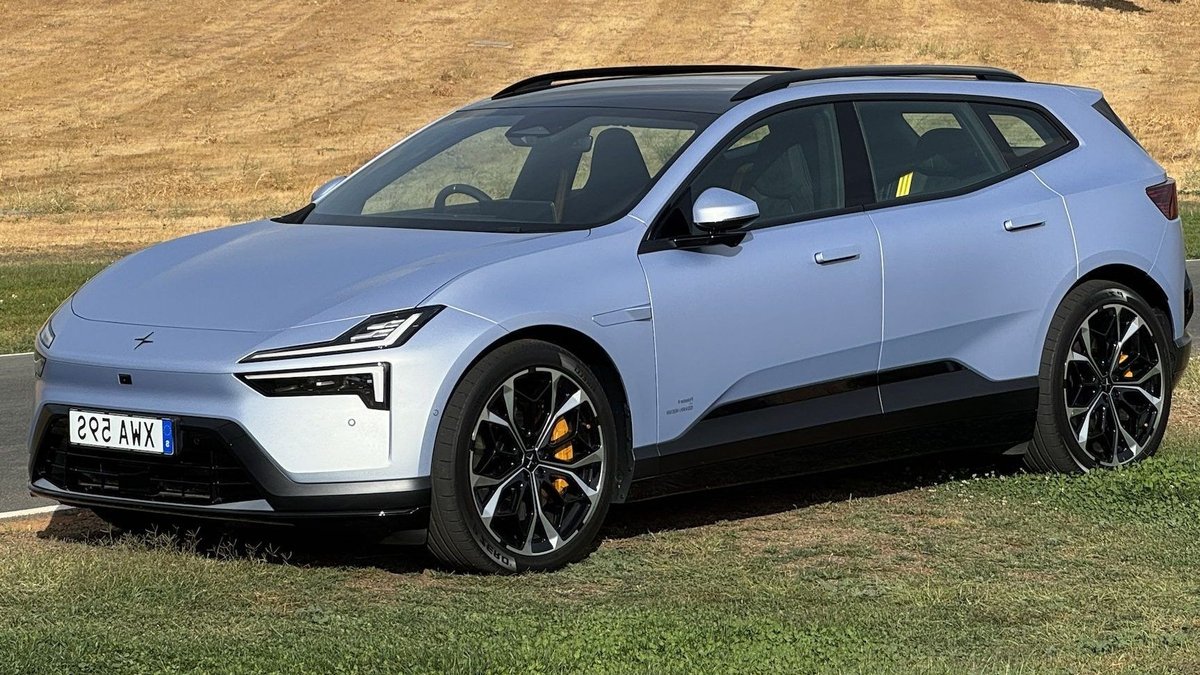
The Polestar 4 has always been an outlier in the crowded electric crossover market. When it debuted in 2023, it arrived as a fastback-styled “coupe crossover,” a category-defying design that swapped traditional rear glass for a sleek, windowless roofline. The move was bold—even polarizing. Delivery vans had long relied on backup cameras, Polestar argued, so why did a luxury EV need a rear window? Yet the decision left some buyers and critics puzzled, especially when paired with a compact cargo hold that prioritized style over utility.
Polestar 4 Now Comes as SUV
Now, Polestar is evolving. The brand has split its lineup, renaming the original model the Polestar 4 Coupe and introducing a new Polestar 4 SUV—one with a conventional roofline, a full rear window, and 129 liters more cargo space behind the second row. The change isn’t just cosmetic.
It’s a direct response to feedback, though Polestar’s design chief, Philipp Römers, suggests the idea predated his arrival from Audi in 2022. “When I knew my role was coming up at Polestar,” Römers explained to us in an interview, “I looked at the lineup and began sketching out different ideas.” One of those sketches was indeed a machine in the vein of what you see on these digital pages, though it seems Polestar itself may have proactively been considering an SUV-ifying of the 4; Römers’ arrival may have just hastened the process. “It came together quickly with the team,” he said.
The new SUV’s cargo capacity jumps to 655 liters behind the second row (up from 526 liters in the Coupe) and 1,665 liters with the rear seats folded flat. Dimensions remain identical to the Coupe, same length (4,840 mm), same width (2,139 mm), but the shared underpinnings mean Polestar avoided reinventing the wheel. Even the lower rear door panels are shared, a cost-effective way to produce two distinct body styles from a single platform. The SUV’s extra weight (about 60 kilograms more) is offset by stiffer rear springs, revised anti-roll bars, and software tweaks that improve efficiency. Surprisingly, Polestar claims the SUV will outrange the Coupe despite the added mass, thanks to optimized tire choices and powertrain calibration.
Under the hood, the SUV offers the same two powertrain options as the Coupe: a 272-horsepower rear-wheel-drive model and a 544-horsepower dual-motor all-wheel-drive variant. The single-motor version accelerates from 0-100 km/h in a hair over seven seconds, while the dual-motor model does it in less than four ticks. Both use the same 100 kWh battery and support up to 200 kW DC fast charging, though official range figures for the SUV in Canada haven’t been confirmed. Early test results suggest 510 kilometers of range at 98% charge, aligning with the Coupe’s 499-kilometer NRCan rating.
Performance and Handling Match Luxury Rivals
The SUV’s handling aligns with the brand’s roots. A low center of gravity, thanks to the battery’s placement, combines with adjustable suspension and steering settings to deliver a response that feels more engaged than most two-row EVs. The Performance package includes active dampers, while standard models get dampers with a bypass valve for a softer ride. The result is a crossover that doesn’t just compete with the Porsche Macan Electric or other two-row EV crossovers but holds its own against them.
Inside, the SUV carries forward the brand’s signature minimalism. A 15.4-inch touchscreen dominates the dashboard, controlling everything from climate control to mirror adjustments, even steering column tilt requires screen interaction. Sustainability remains a priority, with recycled textiles and ethically sourced leather. Each seatback displays a label: “100% traced leather, animal welfare secured,” a transparency move that sets Polestar apart.
Clearer Lineup, Same Bold Design Roots
Polestar’s naming convention adds another layer of complexity. Unlike BMW or Audi, where model numbers reflect size, Polestar’s 2, 3, 4 sequence denotes launch order. The Polestar 4 is compact, roughly the size of a Tesla Model Y, while the Polestar 3 is a larger SUV akin to the Volvo EX90. The split between Coupe and SUV isn’t just about cargo space; it’s about clarity. Dealers and buyers now have two distinct options, each tailored to different needs.
A journalist who drove the Polestar 4 last year noted its build quality and luxurious interior while questioning the absence of a rear window. This year, the SUV variant resolves that concern with a full rear glass panel and wiper, features some electric vehicle manufacturers overlook. The decision to include a rear wiper reflects an attention to detail often missing in the EV segment, where rear visibility has occasionally been an afterthought.


