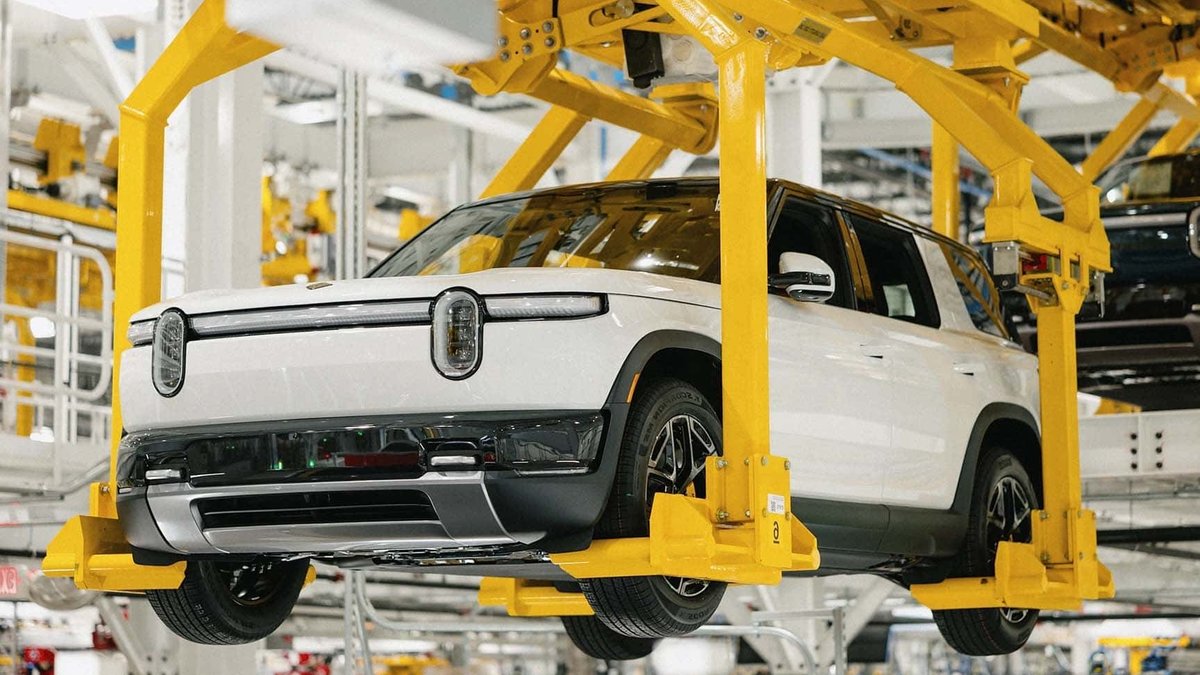
Rivian has invested over $5 million in 3D printing technology, using it to speed up development and production. The company is now scaling up its use of additive manufacturing, adding a bay of machines at its factory in Normal, Illinois. This expansion follows the successful implementation of 3D printers at its Detroit facility, where the technology has been instrumental in creating prototypes and production parts.
Rivian’s 3D Printing Strategy
The California-based startup has been utilizing 3D printers at its Detroit facility to create prototypes of various parts, including the R2’s steering wheel and electric motors for fluid testing. According to Jonathan Dankenbring, Rivian’s head of additive manufacturing, the company plans to “democratize 3D printing” across all its operations. This initiative aims to make 3D printing accessible to every engineer, enabling them to rapidly prototype and test parts. The technology has already been used to produce screw guides for tooling, stamping press inserts, and trim pieces for early vehicle builds.
In addition to the $5 million spent on 3D printers, Rivian invests approximately $1.7 million annually in raw materials for these machines. This significant expenditure is justified by the cost savings and time efficiency achieved through additive manufacturing. By producing parts on-site, Rivian reduces reliance on external suppliers, cutting down both costs and lead times.
Benefits of Additive Manufacturing
By employing 3D printing, Rivian can produce small batches of parts on-site, reducing supplier tooling costs, logistics expenses, and production times. This approach has resulted in millions of dollars in savings compared to traditional prototyping methods. Additionally, the ability to iterate quickly on designs allows engineers to test and refine parts in a fraction of the time it would take with conventional methods.
Industry-Wide Adoption
Rivian is not alone in adopting additive manufacturing. Other major automakers, including Tesla, Ford, and General Motors, have also adopted 3D printing to streamline production and reduce costs. Tesla, for example, has used 3D printing to rectify design errors in the Model Y’s HVAC airbox, while General Motors registered 300 patents for the Cadillac Celestiq, a vehicle heavily reliant on advanced manufacturing techniques. Canada has also entered the fray with Project Arrow, an EV concept featuring a 3D-printed chassis, showcasing the technology’s global impact.
Canada Unveils Project Arrow EV Concept With 3D-Printed Chassis, demonstrating the growing role of additive manufacturing in automotive design. Meanwhile, Tesla Uses 3D Printing To Fix Mistake In Model Y HVAC Airbox, highlighting the technology’s problem-solving capabilities. Additionally, Slate Will Build Its $20,000 Electric Pickup Truck, further illustrating the industry’s shift toward cost-effective and innovative production methods.


