
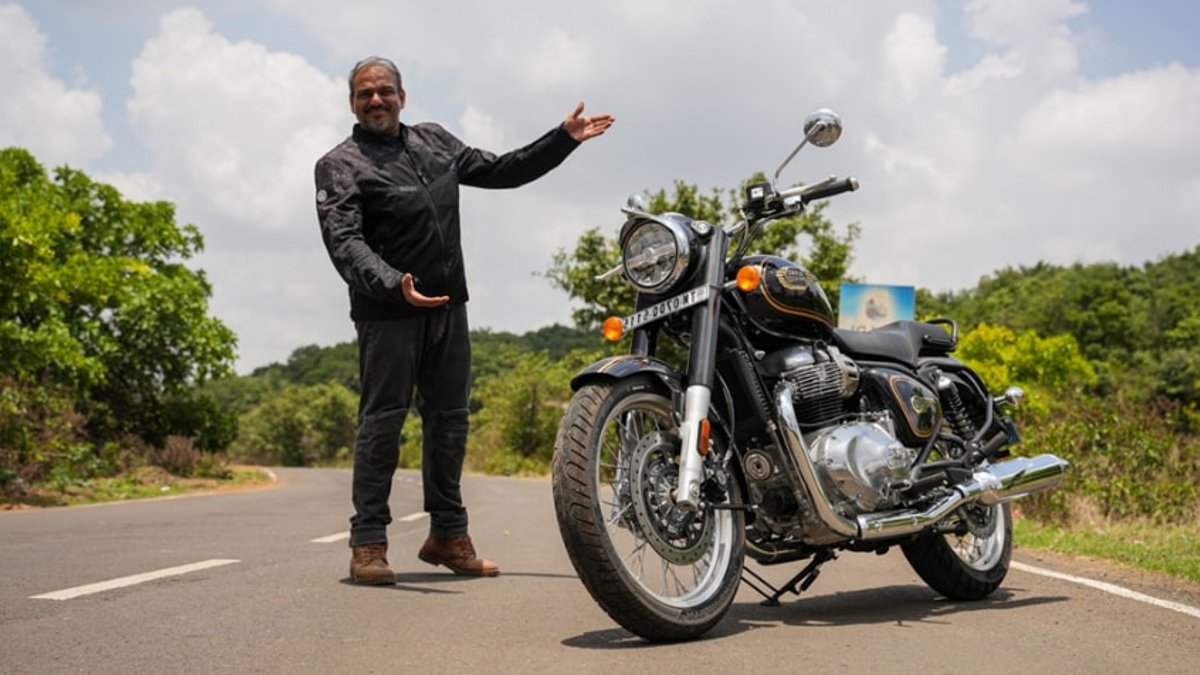
The Royal Enfield Bullet isn’t just another motorcycle—it’s a cultural touchstone in India. For generations, it’s been tied to family rides, police escorts, and long-distance trips, its familiar shape carrying memories of fathers, grandfathers, and roadside mechanics. When Royal Enfield updated the Bullet with a 650cc parallel-twin engine, the question wasn’t whether it was good. It was whether the Bullet needed this at all.
Royal Enfield clearly thought so. The Bullet 650 keeps the brand’s signature DNA intact—a teardrop fuel tank, gold pinstripes, a round headlamp, and a peashooter exhaust—but swaps the old single-cylinder engine for a 647.95cc air-and-oil-cooled twin, producing 47 horsepower and 52.3 Nm of torque. It’s the same powertrain used in the Interceptor, Continental GT, and Classic 650, but here, it’s wrapped in a design that refuses to modernize for the sake of it.
The result is a motorcycle that feels like a time capsule. Chrome isn’t just a finish; it’s a statement. The bench seat isn’t just practical; it’s traditional. And the upright riding position, raised handlebars, and long mudguards aren’t just ergonomic choices; they’re deliberate nods to the Bullet’s heritage. This isn’t a retro revival. It’s a motorcycle that earns its old-school aesthetic.
A Modern Engine in Classic Clothing
Underneath, though, the Bullet 650 is anything but old-school in performance. The twin-cylinder engine is smooth, tractable, and effortless, unlike the old Bullet 500, which relied on patience and planning for overtakes. The 6-speed gearbox shifts cleanly, the slipper clutch disengages without drama, and the twin-channel ABS adds modern safety without sacrificing character. The steering is light, the suspension soaks up bumps, and the 19-inch front wheel gives it a commanding presence on the road.
The biggest change is how the Bullet 650 handles speed. Older Bullets had charm and identity, but they weren’t built for relaxed cruising. This one is. It pulls effortlessly, overtakes without fuss, and stays composed on highways, a far cry from the single-cylinder Bullets that demanded constant attention. Yet for all its refinement, the Bullet 650 isn’t without trade-offs.
Built for Legacy, Not Practicality
At 243 kg, it’s heavy. In city traffic or tight parking spots, the weight is noticeable. The Interceptor 650 feels more nimble, and the Classic 650 offers a similar vintage experience without the extra mass. But that’s the point. The Bullet 650 isn’t designed for rational buyers. It’s for riders who see Royal Enfield through the Bullet lens—those upgrading from a Bullet 350 or an old Classic, who want the same shape, posture, and chrome, but with a bigger engine and more capability.
Read Also: Bajaj Launches Refined New Pulsar 125 and 150 in 2026
The Bullet 650’s design choices extend beyond aesthetics into the very way it moves. The steel tubular spine frame, paired with 41mm front forks and twin rear shocks, ensures stability without sacrificing the classic Bullet feel. The 19-inch front wheel and 18-inch rear wheel setup, larger than the 500’s 17-inch front, give it a broader stance, reinforcing its commanding road presence.
Even the dual-channel ABS, while a modern addition, is calibrated to work with the bike’s upright posture, preventing the kind of over-braking that could unsettle riders accustomed to the Bullet’s traditional handling. The disc brakes at both ends, a first for the Bullet lineup, offer stopping power that older models lacked, though they’re still tuned to avoid the harsh feedback of more aggressive systems.
Design Choices That Define the Bullet
Inside the cockpit, the Bullet 650 retains the bench seat that has defined the Bullet for decades, but with improved padding and support. The raised handlebars and long mudguards aren’t just throwbacks; they’re functional, shielding riders from wind and debris while keeping the bike’s silhouette intact. The tiger-eye turn signals, a subtle but telling detail, echo the classic styling cues that make the Bullet instantly recognizable.
Even the fuel tank’s teardrop shape, a design element that dates back to the 1950s, is preserved, reinforcing the idea that this isn’t just an update but a continuation of a legacy. The absence of digital screens or touch controls further shows Royal Enfield’s commitment to keeping the riding experience uncluttered, prioritizing tactile engagement over modern conveniences.
The weight remains the most tangible compromise. At 243 kg, it’s nearly 50 kg heavier than the Bullet 350, making it less nimble in tight urban conditions. The Interceptor 650, with its more modern frame and lighter components, handles with greater agility, while the Classic 650, sharing the same engine, feels closer to the spirit of the original without the added mass.
But for those who see the Bullet as more than just a machine, the weight is a small price to pay for the emotional resonance of its design. The Bullet 650 doesn’t just perform; it performs with the authority of a motorcycle that has carried generations of riders through India’s roads, from sunrise police patrols to late-night college rides. In that sense, the trade-offs are part of the package.


