
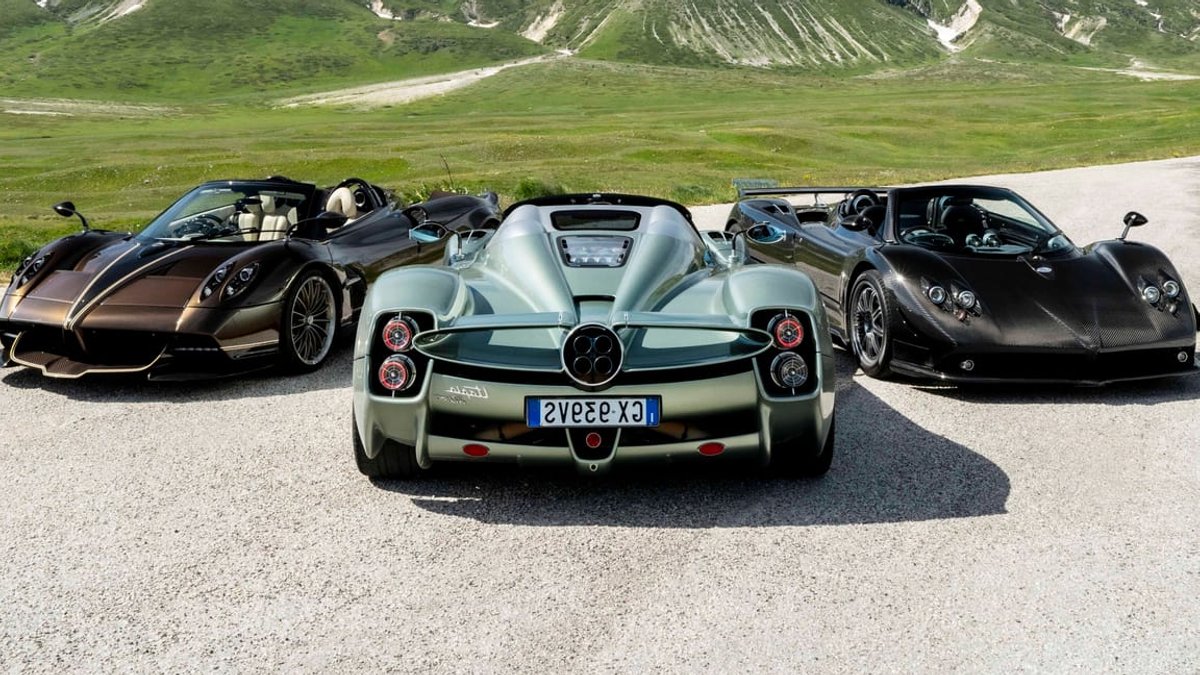
A few days of driving on Italy’s scenic roads in three generations of Pagani roadsters began with a meeting with Horacio Pagani, the company’s founder. He lent two of his personal cars, an exposed carbon fiber Zonda F Roadster and the unique Huayra Roadster HP, for the drive. The latest Utopia Roadster, a seven-speed manual version in Verde Mara, was also part of the lineup.
The meeting took place at the Pagani factory, known as the Atelier, a haven of craftsmanship and attention to detail. The facility was filled with cars in various stages of production, from bare chassis to nearly completed vehicles. Horacio Pagani showed off the company’s capabilities, including steering wheels machined from solid aluminum billets and carbon fiber chassis fresh from the autoclaves.
Pagani’s History and Philosophy
The Zonda F Roadster, fresh from a full restoration, was valued at around $15 million, given that a similar Cinque Roadster was recently sold for over $20 million. Despite its value, the car did not feel like a burden to drive, and its 7.3-liter V12 engine delivered a glorious noise and a sense of occasion. The Huayra Roadster HP, on the other hand, was a more intense and overwhelming experience, with a twin-turbocharged V12 engine and a seven-speed automated manual gearbox.
The Utopia Roadster, the latest model, was a reimagined and reinvigorated version of the Zonda F, with a manual gearbox and a more subdued design. It had a unique exhaust sound and a sense of occasion that was hard to match. The car’s philosophy aligned perfectly with Horacio Pagani’s initial supercar ideals, and it seemed to embody the company’s design heritage and attention to detail.
Read Also: Lo-Fi Design Fuels Resident Evil 2 Enduring Fear
Driving the Pagani Roadsters
The three Roadsters were parked side by side, showcasing their unique designs and characteristics. The Zonda F Roadster had a normally aspirated M120 Mercedes-AMG 7.3-liter V12 engine, producing 650bhp at 6,200rpm. The Huayra Roadster HP had a twin-turbocharged M158 AMG V12 engine, producing 802bhp, while the Utopia Roadster had a turbocharged V12 engine, producing 864bhp. Each car had its own distinct personality and driving experience, from the Zonda’s razor-sharp freshness to the Huayra’s intense and overwhelming performance.
As the drive began, the Zonda F Roadster’s engine sounded huge, with a mix of hard-edged responsiveness and honey-coated smoothness. The car’s steering was light and clean, and its structure was rock-solid, allowing for a superb lightness of touch and control. The Huayra Roadster HP, on the other hand, was a snorting, whistling, roaring monster, with a relentless and manic energy that was at odds with its sophisticated design.
The Utopia Roadster, with its seven-speed manual gearbox and twin-turbocharged V12 engine, was a stunning achievement, feeling alive and responsive. Its design was a perfect blend of supercar madness and sculptural beauty, with a complex but effortless look that seemed to embody Italy’s design heritage. As the drive continued, it became clear that each car had its own unique strengths and weaknesses, and that the Utopia Roadster was perhaps the most complete and appealing of the three.
The Utopia Roadster’s gearbox had a lovely shift quality, but was awkward at first, with four planes and a springing that put fourth and fifth gears in the neutral position. However, once the driver was accustomed to the weighting required to steer it cleanly around the gate, it was fabulous. The big V12 engine was not a high-revving affair, but the sound quality was intriguing, with a V12 howl overlaid by turbochargers and intake noise. The car’s performance was vast, and its chassis delivered a beautifully judged blend of outright grip and subtle, transparent adjustability.
Read Also: Ceer Motors debuts first electric sedan and SUV
Inside the Pagani Atelier
The workshop displays cars in various stages of construction. Some are bare chassis while others are nearly finished. The facility also holds cars from Pagani’s own collection. These include rare Zonda C12 chassis and extreme track-only variants. The cars are often hidden from view but receive the same care as those with exposed interiors.
The Legacy of the Roadsters
The Zonda F Roadster stands as a bridge between the company’s past and present. Its 7.3-liter V12 engine produces 650 horsepower and revs to 6,200 rpm. This powerplant delivers a sound that blends hard-edged responsiveness with honey-coated smoothness. The car weighs just 1,230 kilograms (dry). This low weight contributes to its razor-sharp handling and rock-solid structure. The interior features leather, wood, and carbon fiber. It offers a unique and sumptuous space that feels both simple and extravagant.
The Huayra Roadster HP represents a different evolution. It uses a twin-turbocharged M158 AMG V12 engine. This power unit generates 802 horsepower. The car utilizes hardware from the track-focused BC Roadster but tones down the aerodynamics. This creates a more supple ride while maintaining immense performance. The automated manual gearbox shifts with precision and hard impact. The active aerodynamics front and rear adapt to the driving conditions. It is a snorting, whistling, and roaring monster that is at odds with its sophisticated design.
The Utopia Roadster returns to the company’s roots. It features a seven-speed manual gearbox with a dogleg for first gear. This transmission has a lovely shift quality, though it requires a few minutes to master. The springing of the gates places fourth and fifth gears in a neutral position initially. Once the driver adapts to the weighting, the operation becomes fabulous. The V12 engine produces 864 horsepower. The chassis delivers a blend of grip and adjustability. It feels alive and responsive, capturing the essence of Pagani’s design heritage.


